


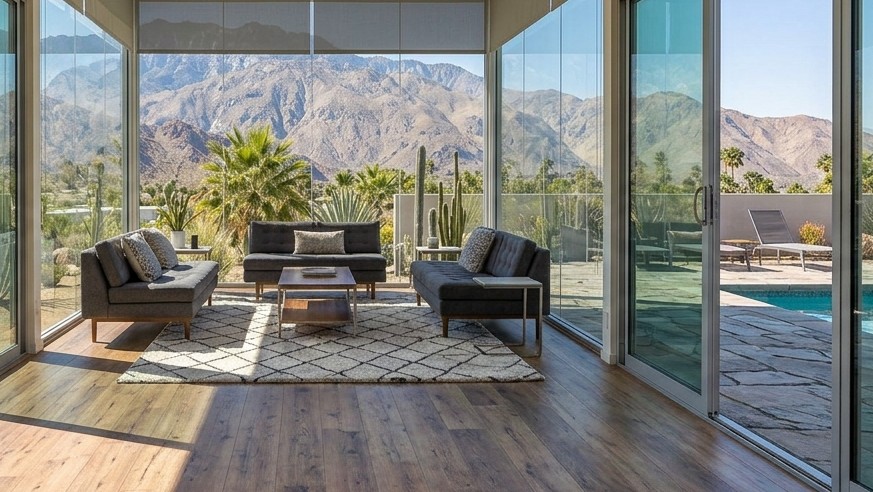
Glass walls and open desert views make sunrooms the centerpiece of Coachella Valley homes, but extreme solar exposure puts immense stress on interior finishes. Unfiltered sunlight streaming across an enclosed patio pushes floor surface temperatures past 120 degrees within hours. You can install modern laminate flooring in a desert sunroom, but success depends entirely on selecting high-density planks with UV-stable wear layers and maintaining proper perimeter expansion spacing during installation.
Thermal Expansion and Solar Load in Enclosed Glass Spaces
Sunrooms in Palm Springs and Cathedral City function as architectural solariums, capturing intense radiant heat throughout the afternoon. Standard floating floors expand and contract as temperatures swing between cool desert mornings and scorching summer afternoons. When low-grade flooring materials overheat, the core softens, causing the boards to buckle, cup, or push against drywall perimeters.
High-performance laminate handles thermal swings through a dense, pressurized construction:
High-Density Fiberboard (HDF) Cores: A high-density core resists dimensional shifting under direct radiant heat, keeping the planks flat and joints locked tight.
Commercial-Grade Aluminum Oxide Wear Layers: Advanced top coatings block harsh ultraviolet rays to prevent sun bleaching across high-exposure zones next to sliding doors.
Direct-Pressure Laminate Construction: Fused layered materials eliminate the risk of surface delamination when solar heat concentrates along glass perimeters.
The Essential Installation Rules for High-Heat Sunrooms
Installing floating laminate in a sunroom calls for strict adherence to climate-engineered installation practices. Skipping these steps leads to peaked plank edges and separated click-lock channels.
Generous Perimeter Expansion Gaps
Every floating floor needs room to expand as interior temperatures climb. Standard residential installations call for a quarter-inch gap along walls. In an enclosed desert sunroom exposed to intense radiant heat, your installation team must leave a wider half-inch expansion gap around all baseboards, sliding door tracks, and structural posts. Quarter-round or wide baseboards conceal this gap completely while giving the planks the room they need to breathe.
Continuous Subfloor Vapor Barriers Over Concrete
Most Coachella Valley sunrooms are built directly over existing concrete patio slabs. Concrete slabs absorb subterranean moisture and release invisible vapor upward into your sunroom. Laying a dedicated 6-mil moisture barrier or using a premium underlayment with an integrated vapor seal keeps rising moisture from reaching the underside of the laminate core.
Controlled Climate and Air Circulation
While modern laminate handles elevated temperatures better than vinyl, enclosed sunrooms need basic ventilation during peak July and August heat. Keeping a ceiling fan running, maintaining basic airflow, or drawing solar shades during triple-digit heatwaves keeps ambient room conditions within the safe performance limits of the floor.
Thermal Underlayment: Protecting Planks from Slab Heat Transfer
Concrete patio slabs act like massive thermal sponges, soaking up ground heat and radiating it upward into your sunroom floor all day long. Laying laminate directly over hot concrete without a dedicated thermal barrier exposes the underside of your planks to extreme temperature differences between the top wear layer and the bottom core.
A dense acoustic-and-thermal underlayment creates a crucial insulating buffer between the slab and your laminate:
Thermal Insulation: Reflective or high-density underlayment limits the rate of heat transfer from the slab into the room, helping your floor maintain a stable core temperature.
Joint Protection: High-compression underlayments do not collapse under heavy point loads, keeping the click-lock joints rigid when you walk across the floor.
Acoustic Deadening: Heavy glass sunrooms often echo; dense underlayment cushions footsteps and absorbs ambient noise bouncing off expansive window walls.
Sand Resistance and Indoor-to-Outdoor Durability
Sunrooms serve as the primary transition zone between your indoor living room and outdoor pool deck or desert landscape. Windblown sand tracked in from patio decks acts like coarse sandpaper under shoes and bare feet, quickly wearing down soft or poorly finished materials.
High-density laminate carries an Abrasion Class rating of AC4 or AC5, giving you commercial-grade scratch resistance against abrasive grit. Fine blow-sand sweeps off the smooth wear layer effortlessly with a dry microfiber mop. The non-porous surface also resists chlorine tracks from wet feet and spilled beverages without leaving water rings or cloudiness on the finish.
Plan Your Sunroom Floor with Flooring Innovations
Selecting the right laminate for an enclosed desert sunroom comes down to matching your floor material to the solar load and daily use of your space. Flooring Innovations brings over two decades of local Coachella Valley experience to help you choose climate-engineered surfaces that stand up to intense heat, direct sunlight, and daily sand.
Visit our showrooms in Palm Desert or Cathedral City to see our high-performance laminate selections in person, or contact our team today to schedule your design consultation.


